India’s No. 1 Online Admission Portal
Apply Now

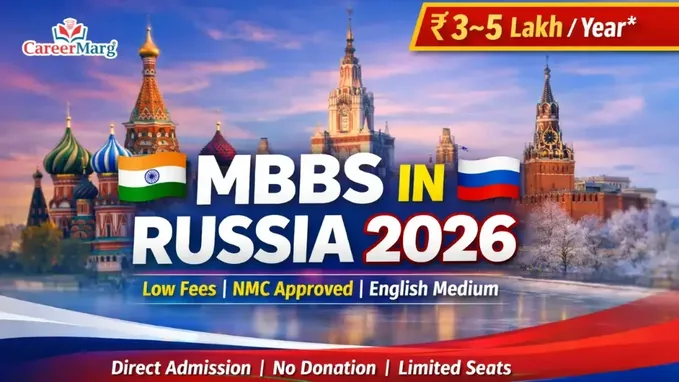
MBBS in Russia is a popular choice among Indian students seeking medical education abroad, particularly because of the availability of established medical universities, English-medium programs and comparatively affordable tuition fees. Russian medical universities have a long history of medical education and offer undergraduate medical programs to students from India and other countries.
For Indian students, choosing the right university involves more than comparing tuition fees. The university's recognition in Russia, medical curriculum, duration of study, clinical training, internship structure, medium of instruction and compliance with the applicable National Medical Commission (NMC) regulations are important factors to evaluate before admission. These considerations are particularly important for students who intend to return to India and pursue medical practice after completing their degree.
For the 2026-27 academic session, MBBS in Russia offers students a range of university and city options with different fee structures, academic environments and clinical facilities. Students should compare the total cost of education, quality of clinical exposure, teaching facilities, accommodation, student support and future licensing requirements before making a decision.
This guide provides a detailed overview of MBBS in Russia for Indian students, including eligibility, NEET requirements, fees, course duration, admission process, documents, leading medical universities, clinical training and the requirements that Indian graduates need to consider for their medical career after studying in Russia.
| Feature | Details |
| Country | Russia |
| Medical Degree | Medicine / MD, with degree nomenclature varying by university and programme |
| Course Duration | Typically 6 years, depending on the university and programme structure |
| Eligibility | Class 12 with Physics, Chemistry and Biology/Biotechnology, subject to applicable eligibility requirements |
| NEET Requirement | Yes, applicable for Indian students as per prevailing Indian regulations |
| Entrance Exam | University-specific; admission requirements may vary between medical universities |
| Medium of Instruction | English-medium medical programmes are available; Russian may also be used depending on the programme and clinical setting |
| NMC Requirements | Students should verify that the specific university and medical programme comply with applicable NMC and Foreign Medical Graduate regulations |
| Tuition Fees | Varies by university, city and programme; students should check the latest official fee structure |
| Hostel Fees | Varies by university, accommodation type and location |
| Total Cost | Depends on tuition fees, hostel, living expenses, insurance, visa, travel and other personal expenses |
| Living Cost | Varies by city and individual lifestyle |
| Popular Cities for Medical Education | Moscow, Kazan, Saint Petersburg, Rostov-on-Don, Novosibirsk and other university cities |
| Main Intake | Generally September; additional intakes depend on the university and programme |
| Accommodation | University hostels and private accommodation may be available, depending on the university and city |
| Hostel Facilities | Facilities vary by university and may include furnished rooms, heating, internet access, common areas and security |
| Food | Food options vary by university and city; Indian food may be available in some universities and major cities |
| Indian Student Community | Indian students are present at several Russian medical universities; community size varies by institution |
| Clinical Training | Clinical education forms part of the medical programme; the timing, hospitals and training structure vary by university |
| Russian Language | Basic Russian can be useful for daily communication and patient interaction during clinical training |
| Documents Required | Passport, Class 10 and 12 certificates/marksheets, NEET documents where applicable, photographs, medical documents and university-specific paperwork |
| Admission Process | Eligibility check, university selection, application, admission documentation, visa processing and university registration |
| Visa | Indian students generally require a Russian student visa; processing requirements and timelines may vary |
| Career in India | Graduates seeking medical practice in India must meet the applicable NMC requirements and licensing process |
| Career Abroad | Graduates may explore licensing or postgraduate pathways in other countries, subject to the requirements of the respective country |
| Key Factors to Check | University status, programme structure, medium of instruction, clinical training, internship arrangements, total cost and applicable Indian regulations |
| Best Reason to Consider Russia | Multiple medical university options, international student environment and availability of English-medium medical programmes |
Russian medical universities offer students access to established medical education, experienced faculty and modern learning facilities. Several universities offer medical programs in English, making MBBS in Russia for Indian Students a popular option for studying medicine abroad. However, students should verify the specific university, programme, clinical training and applicable NMC (National Medical Commission) requirements before admission. The following factors make MBBS in Russia for Indian Students a destination worth considering:
Indian students planning to study MBBS in Russia must meet the applicable academic, age and NEET requirements. Eligibility can also vary slightly depending on the university and programme, so students should always verify the latest admission criteria before applying.
| Details | Requirements |
| Entrance Exam | NEET qualification is required for Indian students seeking admission to undergraduate medical programmes abroad, as per applicable Indian regulations. |
| Academics | Candidates should have completed Class 12 with Physics, Chemistry and Biology/Biotechnology and meet the applicable minimum marks requirements. |
| Age Requirement | The student should meet the applicable age requirement, generally 17 years by 31 December of the admission year. |
| English Requirement | English should be studied as a subject at the qualifying level, subject to applicable eligibility requirements. |
| Medical Fitness | Students may need to submit a medical fitness certificate and other health-related documents as required by the university or visa process. |
| Passport | A valid passport is required for the admission and student visa process. |
Choosing a medical university is about more than comparing tuition fees. Indian students should evaluate the university, medical programme, clinical training, total cost and applicable NMC requirements before making a final decision.
The MBBS in Russia admission process for Indian students involves selecting a suitable medical university, checking eligibility, submitting the required documents, completing university formalities and applying for a student visa. The exact admission requirements, fees and timelines can vary between universities, so students should verify the latest university and regulatory requirements before applying.
The documents required for MBBS admission in Russia may vary by university and visa requirements. Commonly requested documents include:
Students should keep both original documents and required copies ready and verify the latest document checklist before submission.
Indian students completing a foreign medical programme should understand the current Indian licensing requirements for foreign medical graduates before choosing a university in Russia.
Important: FMGE/NExT requirements, examination structure and implementation timelines can change. Students should verify the latest information from official NMC sources before making admission decisions.
Russian medical universities offer a range of healthcare and medical-related programmes for international students. For Indian students, General Medicine (MBBS/MD) is the most relevant programme for those planning to pursue a medical career. Other healthcare programmes may also be available, depending on the university and admission requirements.
The MBBS syllabus in Russia is designed to provide students with a combination of basic medical sciences, pre-clinical subjects, clinical subjects and practical training. The exact curriculum, subject sequence and clinical rotation structure may vary between universities. Students should therefore check the official curriculum of their selected medical university before admission.
The following is a general overview of subjects commonly covered across different stages of medical education in Russia:
| Semester | Major Subjects and Areas of Study |
| 1st Semester | Medical Biology, Anatomy, Chemistry, Medical Physics and Mathematics, Russian Language, Latin Language, History of Medicine, Philosophy and Information Technology in Medicine |
| 2nd Semester | Cytology, Embryology and Histology, Biochemistry, Anatomy, Medical Biology, Russian Language, Pedagogy and Psychology, History of Medicine and First Aid |
| 3rd Semester | Life Safety and Disaster Medicine, Microbiology and Virology, Medical Informatics, Clinical Physiology, Bioethics, Russian Language, Histology and other basic medical sciences |
| 4th Semester | Biochemistry, Propaedeutics of Internal Diseases, Radiodiagnosis, Hygiene, Anatomy of the Nervous, Immune and Endocrine Systems, Medical Economics, Jurisprudence and Russian Language |
| 5th Semester | General Surgery, Radiodiagnosis, Pathological Physiology, Pathological Anatomy, Pharmacology, Topographical Anatomy and Operative Surgery, Immunology and Propaedeutics of Internal Diseases |
| 6th Semester | Obstetrics and Gynecology, General Surgery, Urology, Neurology, Medical Genetics and Neurosurgery, Pharmacology, Pathological Anatomy, Public Health and Health Care |
| 7th Semester | Pediatrics, Ophthalmology, Facultative Therapy, Professional Diseases, Obstetrics and Gynecology, General Surgery, ENT and Medical Rehabilitation |
| 8th Semester | Neurology, Neurosurgery, Urology, Pathological Physiology, Pharmacology, Topographical Anatomy, Operative Surgery, Public Health and Propaedeutics of Internal Diseases |
| 9th Semester | Outpatient Therapy, Hospital Therapy, Endocrinology, Hospital Surgery, Pediatric Surgery, Infectious Diseases, Pediatrics, Orthopedics and Traumatology, Psychiatry and Medical Psychology |
| 10th Semester | Orthopedics and Traumatology, Outpatient Therapy, Forensic Medicine, Clinical Pharmacology, Epidemiology, Infectious Diseases, Obstetrics and Gynecology and Hospital Therapy |
| 11th Semester | Anesthesiology, Resuscitation and Intensive Therapy, Oncology and Radiology, Functional Diagnostics, Phthisiatry, Stomatology, Dermatology and Venereology, Pediatrics and Hospital Surgery |
| 12th Semester | Clinical Allergology, Anesthesiology, Intensive Therapy, Oncology, Radiology, Hospital and Outpatient Clinical Training, along with other university-specific clinical subjects and practical training |
Important: The subjects listed above are a general representation of medical education in Russia and should not be treated as the exact syllabus of every Russian medical university. The curriculum, subject distribution, practical training and clinical rotations may differ by institution.
FMGE (Foreign Medical Graduate Examination) is the screening examination applicable to eligible Indian citizens or overseas citizens of India who obtain primary medical qualifications from medical institutions outside India, subject to the applicable regulations. Students planning to study MBBS in Russia should understand the current Indian licensing requirements before selecting a university.
FMGE performance can vary significantly from year to year and between universities. Therefore, students should not select a Russian medical university solely on the basis of an advertised FMGE pass percentage. Instead, they should consider the university's curriculum, clinical training, medium of instruction, academic support, student outcomes and compliance with applicable NMC requirements.
FMGE results can vary according to the examination session, number of candidates, university, preparation level and other factors. There is no reliable single pass percentage that represents every Russian medical university. Students should refer to official examination data or clearly sourced university-level data when comparing FMGE performance.
| University / Country | FMGE Performance | What Students Should Check |
| Russian Medical Universities | Varies by university and examination session | Recent official or verifiable FMGE data, curriculum, clinical exposure and academic support |
| Other Foreign Medical Destinations | Varies by country, university and examination session | Recent FMGE results, programme structure, clinical training and applicable NMC requirements |
Note: FMGE results change from one examination session to another. Students should be cautious of counselling websites or agents that publish unsupported university-specific pass-rate claims. A high advertised pass percentage should always be checked against a reliable source before using it to make an admission decision.
Important: Completing MBBS in Russia does not automatically guarantee eligibility to practise medicine in India. Graduates must satisfy the applicable NMC requirements and Indian medical licensing process in force at the relevant time.
The cost of studying MBBS in Russia varies depending on the medical university, city, programme, tuition structure and accommodation. For Indian students, it is important to compare the complete cost of education rather than looking only at annual tuition fees. The total budget may include tuition, hostel, living expenses, insurance, visa, travel and other university-specific charges.
MBBS in Russia for Indian Students Fees can vary significantly between universities. The following table provides a university-wise fee comparison. Students should verify the latest fee structure directly with the selected university before making any payment.
| Russian Medical University | Tuition Fee (RUB/Year) | Tuition Fee (Approx. INR/Year) | Hostel Fee (RUB/Year) | Hostel Fee (Approx. INR/Year) |
| Siberian State Medical University | 4,10,000 RUB | Approx. ₹5.2 Lakh | 80,000 RUB | Approx. ₹1.0 Lakh |
| Kemerovo State Medical University | 3,35,000 RUB | Approx. ₹4.3 Lakh | 1,00,000 RUB | Approx. ₹1.3 Lakh |
| Voronezh State Medical University | 4,65,000 RUB | Approx. ₹5.9 Lakh | 80,000 RUB | Approx. ₹1.0 Lakh |
| Volgograd State Medical University | 5,05,000 RUB | Approx. ₹6.5 Lakh | 1,05,000 RUB | Approx. ₹1.3 Lakh |
| Bashkir State Medical University | 4,05,000 RUB | Approx. ₹5.2 Lakh | 14,000 RUB | Approx. ₹18,000 |
| North Caucasian State Academy | 3,50,000 RUB | Approx. ₹4.5 Lakh | 12,000 RUB | Approx. ₹15,000 |
| Chechen State University | 3,00,000 RUB | Approx. ₹3.8 Lakh | 83,000 RUB | Approx. ₹1.1 Lakh |
| Chuvash State Medical University | 3,25,000 RUB | Approx. ₹4.1 Lakh | 81,000 RUB | Approx. ₹1.0 Lakh |
| Privolzhsky Research Medical University | 5,30,000 RUB | Approx. ₹6.8 Lakh | 1,00,000 RUB | Approx. ₹1.3 Lakh |
| Pitirim Sorokin Syktyvkar State University | University-specific | Verify latest fee | 50,000 RUB in the first year; may vary thereafter | Verify latest fee |
Note: INR values are approximate and can change with the RUB-INR exchange rate. Tuition and hostel fees may also change by academic year. Students should confirm the latest official fee structure, payment schedule and additional charges before admission.
The cost of living in Russia depends mainly on the city, accommodation type and individual lifestyle. Major cities such as Moscow and Saint Petersburg can have higher living expenses, while smaller university cities may offer more affordable options. Students should budget separately for accommodation, food, transportation, mobile services and personal expenses.
| Expense Category | Estimated Monthly Cost (RUB) |
| Rent / Shared Accommodation | 15,000–30,000 RUB |
| Utilities | 2,000–5,000 RUB |
| Groceries | 8,000–15,000 RUB |
| Public Transportation | 1,500–3,000 RUB |
| Dining Out | 2,000–5,000 RUB |
| Internet & Mobile | 500–1,500 RUB |
| Personal & Miscellaneous Expenses | 3,000–5,000 RUB |
Note: These figures are indicative estimates only. Actual expenses can vary considerably depending on the city, accommodation and lifestyle of the student.
Scholarships may help eligible international students reduce the cost of studying in Russia. Availability, eligibility and funding depend on the scholarship programme, university and applicable government policies. Some scholarships may provide financial support towards tuition or living expenses, while others may have different benefits and conditions.
Indian students should check the latest scholarship availability, eligibility criteria, application deadlines and funding conditions through official Russian government or university sources before relying on a scholarship for their education budget.
Many Russian medical universities provide hostel accommodation for international students. Hostel facilities, room types, charges and availability differ from one university to another. Students should check the university's current accommodation policy before admission.
Depending on the university and hostel, facilities may include:
Important: Hostel facilities should be checked university by university. Availability of Indian food, Wi-Fi, laundry, cooking facilities, air conditioning and other amenities is not the same across all Russian medical universities.
Several Russian medical universities offer medical programmes to international students, including Indian students. Instead of choosing a university only by ranking or advertised fees, students should compare the medical programme, tuition fees, clinical training, medium of instruction, accommodation and applicable NMC requirements.
Note: This list is for informational comparison and should not be interpreted as a fixed ranking. University status, programme availability, fees and admission requirements should be verified before application.
Studying MBBS in Russia can be an option for Indian students who are considering medical education abroad. Russian medical universities offer different programme structures, locations and fee levels, allowing students to compare options according to their academic profile and budget. However, university selection should always include a review of clinical training and applicable Indian regulatory requirements.
Indian students should not select a Russian medical university solely because an admission consultant or website describes it as an "NMC-approved university." The important consideration is whether the specific medical programme and the student's course of study meet the applicable NMC and Foreign Medical Graduate requirements.
Before taking admission, students should verify the university and programme against the latest applicable Indian regulations, including requirements related to course duration, medium of instruction, clinical training, internship or clerkship and other conditions relevant to foreign medical graduates.
The following universities can be considered for comparison by Indian students. The information below should be reviewed and updated using current official university sources before publication.
Siberian State Medical University is a medical university in Tomsk, Russia, with a long history of medical education. International students should evaluate its current medical programme, medium of instruction, tuition fees, clinical training and applicable requirements before applying.
| Attribute | Details |
| Established | 1878 |
| Location | Tomsk, Russia |
| Medium of Education | Programme-specific; verify current university information |
| Course Duration | Programme-specific; verify current structure |
| Eligibility | Subject to university admission criteria and applicable Indian requirements |
| Admission | Check current admission status and deadlines |
Kemerovo State Medical University is located in Kemerovo, Russia. Indian students considering the university should review its current medical programme, tuition fees, admission requirements, clinical training and accommodation facilities before applying.
| Attribute | Details |
| Established | 1955 |
| Location | Kemerovo, Russia |
| Medium of Education | Programme-specific; verify current university information |
| Course Duration | Programme-specific; verify current structure |
| Eligibility | Subject to university admission criteria and applicable Indian requirements |
| Admission | Check current admission status and deadlines |
Voronezh State Medical University is a medical university located in Voronezh, Russia. It offers medical education and has an international student community. Students should verify the current programme structure, tuition fees, medium of instruction, clinical training and admission requirements before applying.
| Attribute | Details |
| Established | 1930 |
| Location | Voronezh, Russia |
| Medium of Education | Programme-specific; verify current university information |
| Course Duration | Programme-specific; verify current structure |
| Eligibility | Subject to university admission criteria and applicable Indian requirements |
| Admission | Check current admission status and deadlines |
Volgograd State Medical University is located in Volgograd, Russia. The university provides medical education to domestic and international students. Indian applicants should compare the current tuition fees, programme structure, clinical training, accommodation and admission requirements before making a decision.
| Attribute | Details |
| Established | 1935 |
| Location | Volgograd, Russia |
| Medium of Education | Programme-specific; verify current university information |
| Course Duration | Programme-specific; verify current structure |
| Eligibility | Subject to university admission criteria and applicable Indian requirements |
| Admission | Check current admission status and deadlines |
Bashkir State Medical University is located in Ufa, Russia, and provides medical education across various levels. International students should verify the current medical programme, tuition fees, accommodation, clinical training and admission criteria before applying.
| Attribute | Details |
| Established | 1932 |
| Location | Ufa, Russia |
| Medical Education | Medical programmes for domestic and international students |
| Eligibility | Subject to university admission criteria and applicable Indian requirements |
| Admission | Check current admission status and deadlines |
North Caucasian State Medical Academy is located in Cherkessk, Russia. Students should evaluate the university based on its current medical programme, facilities, clinical training, accommodation, tuition fees and applicable admission requirements.
| Attribute | Details |
| Location | Cherkessk, Russia |
| Medium of Education | Programme-specific; verify current university information |
| Course Duration | Programme-specific; verify current structure |
| Eligibility | Subject to university admission criteria and applicable Indian requirements |
| Admission | Check current admission status and deadlines |
Crimea Federal University is located in Simferopol. Students considering this university should independently verify its current programme availability, admission process, travel considerations, tuition fees, clinical arrangements and applicable requirements before applying.
| Attribute | Details |
| Location | Simferopol, Russia |
| Programme | Check current medical programme availability |
| Tuition Fees | Verify latest official fee structure |
| Accommodation | Verify current hostel availability and facilities |
| Admission | Check current admission status and requirements |
Kazan Federal University is a major Russian university located in Kazan. It has an established international student environment and offers medical education. Indian students should review the current medical programme, tuition fees, clinical training, accommodation and applicable Indian requirements before admission.
| Attribute | Details |
| Location | Kazan, Russia |
| University Type | Federal university |
| Medical Programme | Check current programme and medium of instruction |
| Tuition Fees | Verify latest official fee structure |
| Admission | Check current admission status and deadlines |
Orenburg State Medical University is located in Orenburg, Russia, and offers medical education and related healthcare programmes. International applicants should verify current admission requirements, tuition fees, programme structure and clinical training arrangements before applying.
| Attribute | Details |
| Established | 1944 |
| Location | Orenburg, Russia |
| Eligibility | Subject to university admission criteria and applicable Indian requirements |
| Medical Programme | Check current programme availability |
| Admission | Check current admission status and deadlines |
Students choosing between MBBS in India and MBBS in Russia should compare more than tuition fees. Admission competition, total cost, academic environment, clinical training, language, accommodation and future licensing requirements can all influence the decision.
| Factor | MBBS in India | MBBS in Russia |
| Admission | NEET-based admission with competition varying by college and category | Indian students must meet applicable NEET requirements; university admission criteria also apply |
| Tuition Fees | Varies significantly between government and private medical colleges | Varies significantly by university and city |
| Medium of Instruction | Primarily English, with regional-language use depending on location | English-medium programmes are available; Russian can be important in clinical settings |
| Clinical Training | Provided through affiliated teaching hospitals | Provided through university and affiliated clinical facilities; structure varies by university |
| Living Expenses | Varies by city and lifestyle | Varies by Russian city, accommodation and lifestyle |
| Language Consideration | Usually easier for Indian students familiar with English and local languages | Basic Russian can be useful for daily life and patient communication |
| Licensing in India | Subject to applicable Indian medical education and licensing requirements | Foreign medical graduates must satisfy applicable NMC requirements and the Indian licensing pathway |
Indian students can compare Russian medical universities based on academic quality, programme structure, clinical exposure, tuition fees, hostel facilities, location and regulatory requirements. The right university should be selected according to the student's academic profile, budget and long-term career plans rather than relying on a single ranking or fee figure.
| Medical University | Location | Key Factor to Verify |
| Voronezh State Medical University | Voronezh | Medical programme, clinical training and latest fees |
| Orenburg State Medical University | Orenburg | Programme availability and admission requirements |
| Ryazan State Medical University | Ryazan | Programme structure, fees and clinical training |
| Crimea Federal University | Simferopol | Current programme, travel considerations and admission requirements |
| Bashkir State Medical University | Ufa | Programme, fees, hostel and clinical training |
| Smolensk State Medical University | Smolensk | Current programme and international student requirements |
| Siberian State Medical University | Tomsk | Programme, fees and clinical training |
| Kazan Federal University | Kazan | Medical programme and current international admission criteria |
| Volgograd State Medical University | Volgograd | Programme, tuition, hostel and clinical facilities |
| Kemerovo State Medical University | Kemerovo | Programme, fees and accommodation |
| Pirogov Russian National Research Medical University | Moscow | Current international medical programme and admission requirements |
Important: The status, fees, programmes and admission requirements of foreign medical universities can change. CareerMarg should verify university-specific information before publishing or updating this section.
Find answers to the most common questions about MBBS In Russia admissions, eligibility, fees, universities, and the admission process.
The MBBS fees in Russia generally range from around ₹2.5 lakh to ₹6 lakh per year, depending on the university and city. The complete cost can be approximately ₹22 lakh to ₹35 lakh or more, including tuition, hostel and living expenses. Fees vary by university, academic year and exchange rate, so students should confirm the latest fee structure before admission.
To get admission to MBBS in Russia, Indian students generally need to complete 10+2 with Physics, Chemistry and Biology/Biotechnology, qualify NEET and meet the admission requirements of the chosen university. The usual process includes university selection, application, document verification, admission/invitation letter, fee payment, student visa and travel to Russia.
Yes, NEET qualification is required for Indian students seeking admission to a foreign medical course, subject to the latest applicable NMC rules. Students should also satisfy the academic and other eligibility requirements of their chosen Russian medical university.
The General Medicine program in Russia is commonly structured as a 6-year medical course, although the exact curriculum and clinical-training structure can vary between universities. Indian students should verify the complete course duration and internship arrangement before admission.
An MBBS/General Medicine qualification from Russia does not automatically guarantee the right to practise medicine in India. Indian students must complete a medical program that meets the latest NMC requirements applicable to foreign medical graduates and fulfil the applicable registration/licensing requirements after graduation.
MBBS in Russia can be a suitable option for some Indian students because several Russian universities offer established medical programs, international student facilities and comparatively moderate tuition fees. However, students should compare NMC requirements, university recognition, course structure, clinical exposure, medium of instruction, total fees and licensing requirements before choosing a university.
Many Russian universities offer English-medium medical programs for international students, but the exact language of instruction varies by university and program. Learning basic Russian language is highly useful because students may need to communicate with local patients and hospital staff during clinical training.
There is no single entrance examination applicable to every Russian medical university. Admission requirements vary by institution, and some universities may have additional screening or admission requirements. For Indian students, NEET qualification remains an important requirement for studying medicine abroad.
The overall cost depends on the university, city and lifestyle. Apart from tuition, students should budget for hostel accommodation, food, medical insurance, visa expenses, travel, transportation and personal expenses. Smaller Russian cities can have different living costs from major cities such as Moscow and Saint Petersburg, so the total budget should be calculated university by university.
Yes, Indian students can pursue medical registration and practice in India after completing an eligible foreign medical qualification and fulfilling the applicable NMC requirements. The student must meet the current foreign medical graduate licensing and registration requirements before practising medicine in India. Therefore, checking NMC rules before admission is essential.
Stay updated with the latest news, admission updates, alerts and important announcements.
Join Our
Get instant updates and notifications directly on WhatsApp.
Join WhatsApp ChannelJoin Our
Get instant updates and notifications directly on Telegram.
Join Telegram Channel
 NEET Predictor

 Apply Online