India’s No. 1 Online Admission Portal
Apply Now

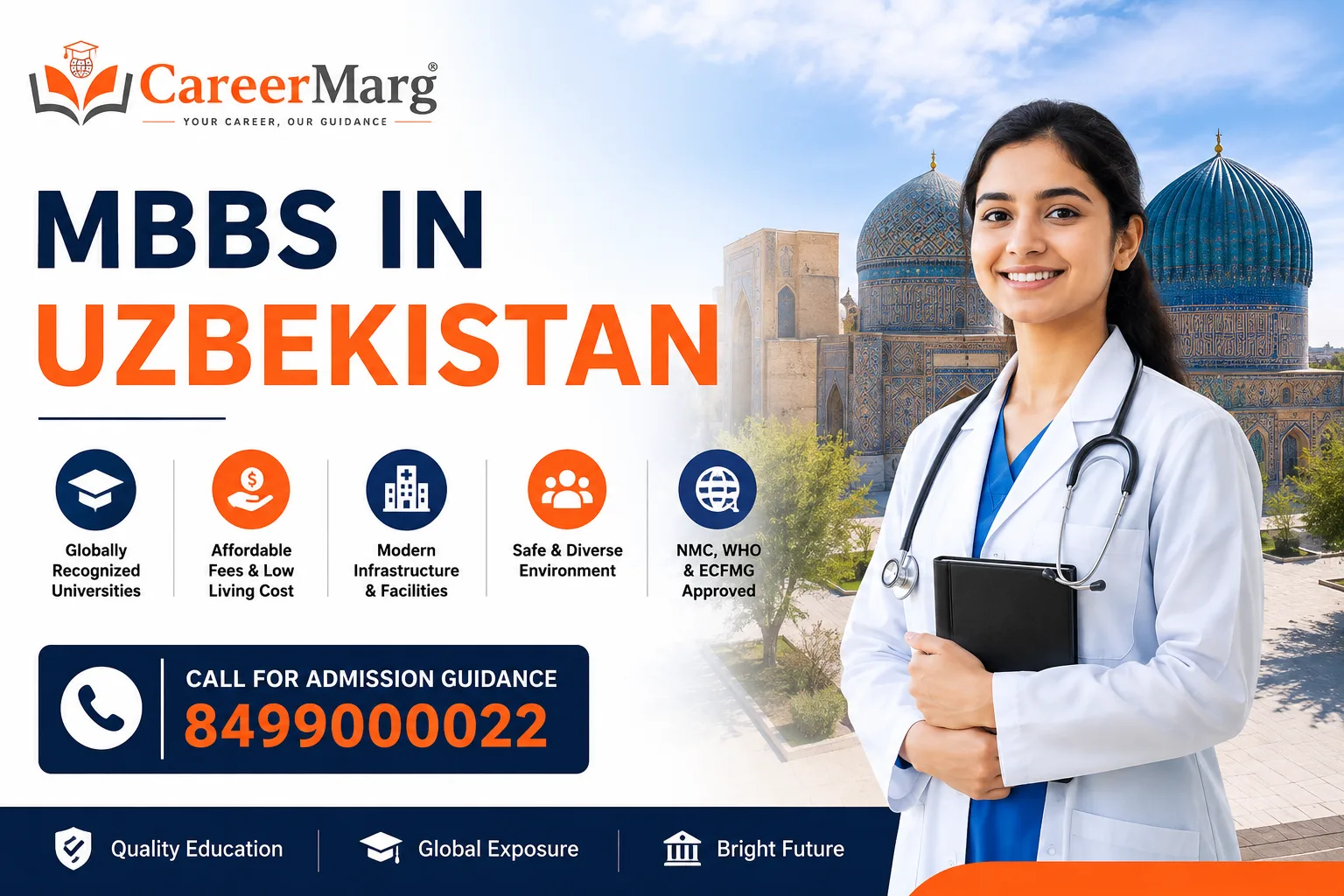
Planning to study MBBS abroad at an affordable cost? MBBS in Uzbekistan has become an increasingly considered option for Indian medical aspirants because of comparatively affordable tuition fees, English-medium medical programs at several institutions, relatively low living costs and the availability of established public medical universities.
However, choosing an Uzbekistan MBBS college should not be based only on low fees or claims such as “WHO approved” or “NMC approved.” For an Indian student who ultimately wants to practise medicine in India, the university, course structure, duration, clinical training, medium of instruction, internship and other requirements must be checked against the applicable National Medical Commission (NMC) regulations.
This complete guide explains MBBS in Uzbekistan, including MBBS in Uzbekistan for Indian students, Uzbekistan MBBS fees, MBBS admission in Uzbekistan, eligibility, NEET requirements, total fees in Indian rupees, top medical colleges, admission procedure, disadvantages, clinical training, hostel and living expenses, and the pathway to medical practice in India.
Important: Fees, admission dates, university names, course structures and regulatory requirements can change. Students should verify the latest information directly with the university and the NMC before paying any admission fee.
| Particular | Details |
| Country | Uzbekistan |
| Capital | Tashkent |
| Medical Course | General Medicine / equivalent undergraduate medical program |
| Typical Duration | Usually around 6 years for programs structured as 5 years of study + 1 year internship |
| Medium | English-medium options are available for international students |
| NEET | Mandatory for Indian students intending to pursue the foreign medical degree for practice in India |
| IELTS/TOEFL | Generally not required by many universities, but verify university-specific rules |
| Class 12 | Physics, Chemistry and Biology required |
| Typical Academic Eligibility | Around 50% PCB for General category under Indian eligibility norms; applicable relaxation should be verified for reserved categories |
| Approx. Tuition | Commonly around USD 3,000–6,000 per year, depending on university/program |
| Hostel | Often approximately USD 500–1,000 per year, depending on institution |
| Living Expenses | Approximately ₹8,000–₹15,000+ per month depending on lifestyle |
| Major Student Cities | Tashkent, Samarkand, Bukhara, Fergana, Andijan |
| Currency | Uzbekistani Som (UZS) |
| Major Concern for Indian Students | NMC compliance, clinical exposure, local-language communication and licensing pathway |
MBBS in Uzbekistan refers to undergraduate medical education offered by medical universities and higher-education institutions in Uzbekistan to domestic and international students.
Uzbekistan is located in Central Asia and has become increasingly visible among international medical students because several institutions offer medical programs to international applicants and some provide English-medium instruction.
For Indian students, the attraction generally comes from a combination of:
However, affordability should never be the only selection criterion.
The critical question for an Indian student is:
Will this specific university and this specific course satisfy the requirements applicable to me under NMC regulations when I graduate?
MBBS in Uzbekistan for Indian students can be an option for candidates who want to pursue medicine abroad, but Indian students must understand the difference between getting admission and being eligible to practise medicine in India.
A university may accept an international student according to its own admission rules. That alone does not guarantee that the graduate will automatically become eligible for medical registration in India.
Indian students should carefully verify:
The total cost can be lower than many private medical education options in India and several other popular destinations.
Students should compare the complete cost, not merely the advertised tuition.
Several universities offer medical programs for international students in English. This can make the academic portion easier for Indian students.
However, English-medium education does not mean that every patient or hospital worker will communicate in English.
Uzbekistan has several long-established public medical institutions and universities that provide medical education to domestic and international students.
Daily living costs may be lower than many Western destinations, although actual expenditure depends on the city and student's lifestyle.
Major university cities have international student communities, including students from India and other countries.
One of the most searched topics is MBBS in Uzbekistan fees. The actual cost depends heavily on the university, program, accommodation, exchange rate and additional charges.
Approximately USD 3,000–6,000 per year may be seen across different programs and institutions. The exact amount must be verified with the university.
Approximately USD 500–1,000 per year may apply depending on the university and accommodation type.
Students may need approximately ₹8,000–₹15,000 or more per month depending on accommodation, food arrangements and lifestyle.
The phrase Uzbekistan MBBS total fees can be misleading because different universities, consultants and websites may include different components in their quoted amount.
One university may quote only tuition while another may quote tuition plus hostel. Therefore, before admission, always ask for a complete six-year written fee structure.
For many students, a broad planning range may be approximately ₹15 lakh–₹30 lakh or more, depending on the university and what is included.
A higher budget may be required after adding food, travel, visa, insurance and miscellaneous expenses.
For Indian families, comparing the complete amount in INR is easier than comparing only USD fees.
A university advertising USD 3,500 per year for tuition does not necessarily mean that the student's complete annual expenditure will be only the INR equivalent of USD 3,500.
The actual calculation should consider:
Tuition + Hostel + Food + Visa + Insurance + Registration + Flights + Other University Charges = Actual Annual Cost
The six-year estimate can then be calculated from the annual cost, while allowing for fee revisions and exchange-rate changes.
| Expense | Approximate Range |
| Tuition | ₹2.5–₹5 lakh/year |
| Hostel | ₹0.4–₹0.9 lakh/year |
| Food | ₹8,000–₹15,000+/month |
| Visa/Registration | Variable |
| Insurance | Variable |
| Flights | Variable |
| Documentation | Variable |
| Estimated 6-Year Budget | Often around ₹15–₹30 lakh+ depending on university and inclusions |
These figures are indicative planning ranges, not university quotations. Students should obtain the official fee structure for their chosen university.
The MBBS admission in Uzbekistan for Indian students generally involves several stages, from eligibility verification to university selection, documentation, admission confirmation and visa processing.
Check:
Submit the documents requested by the selected university.
After evaluation, the university may issue admission confirmation and other documents required for the next stage.
Verify the official invoice, beneficiary details, fee components and refund policy before making payment.
Complete the applicable student visa process using the current official requirements.
After arrival, complete university and local registration requirements before beginning the medical program.
Admission-related expenses are not always the same as tuition fees. Students should request a written breakdown of all mandatory charges.
Ask the university for a six-year projected fee schedule and clarify which expenses are included and which are excluded.
Eligibility should be assessed according to both the university's admission rules and the requirements applicable to Indian students under the relevant regulatory framework.
For Indian medical aspirants, the commonly stated benchmark is 17 years by 31 December of the admission year. Students should verify the rule applicable to their admission year.
Students should have completed Class 12 or equivalent education with the required science subjects, including Physics, Chemistry and Biology/Biotechnology as applicable.
The commonly referenced benchmark is 50% aggregate in PCB for General category candidates, with applicable relaxation for eligible reserved categories.
Students should verify the current NEET and NMC eligibility requirements for their admission year.
Yes. Indian students should qualify NEET when required under the Indian regulatory framework, particularly when they intend to pursue the Indian medical licensing pathway.
A foreign university may have its own admission policy and may accept an international applicant without NEET under its local admission process. That does not automatically remove the requirements applicable under Indian law.
Therefore, students should distinguish between:
The search term "MBBS in Uzbekistan without NEET" attracts considerable attention, but students should be particularly careful with this claim.
Some institutions or intermediaries may advertise admission without NEET. However, Indian students should focus on the regulatory consequences of such admission rather than simply whether a university will issue an admission letter.
If your long-term objective is to return to India and practise medicine, verify NEET eligibility and the applicable NMC requirements before admission and payment.
IELTS and TOEFL are generally not required by many Uzbekistan medical programs for international students, particularly where the program is delivered in English.
However, requirements can vary by university. Students should verify the current admission requirements directly with the institution.
Many Uzbekistan medical programs marketed to international students are structured around approximately 5 years of academic study followed by 1 year of internship, making approximately 6 years in total.
The exact structure is important. Students should verify the curriculum, clinical training and internship arrangements before admission.
English-medium programs are available for international students at several Uzbekistan medical institutions.
Students should distinguish between academic language and clinical communication. Patients may communicate primarily in Uzbek or Russian.
Learning the local language can therefore be useful during clinical postings and hospital interaction.
There is no single universally accepted official "Top 10" ranking specifically for Indian MBBS students. The following institutions are commonly considered by international medical applicants, but students should independently verify current program and regulatory information.
An established medical institution located in Samarkand and one of the universities commonly considered by international medical students.
A major medical university in Tashkent. Students should use the current institutional name when researching admissions and regulatory information.
An established medical institution in Bukhara that is considered by international students seeking medical education in Uzbekistan.
A public medical institution located in Andijan with a long history of medical education.
A medical and public-health institution in Fergana offering health-related higher education programs.
A private higher-education institution with medical education offerings. Students should verify program authorization and NMC-related requirements before admission.
A private university in Tashkent. Students should verify the exact medical program and degree before considering admission.
A historically significant medical institution that has undergone institutional restructuring.
A historically important dental and medical education institution associated with the current restructuring of medical education in Tashkent.
Uzbekistan has additional public and private institutions offering medical and health-related education. Their suitability should be assessed individually.
Instead of asking only "Which is the best Uzbekistan MBBS college?", students should compare universities using objective criteria.
Students should avoid the blanket statement that "all Uzbekistan medical colleges are NMC approved."
Indian regulatory requirements apply to foreign medical graduates, and students must ensure that their chosen institution and medical program satisfy the applicable requirements.
Therefore, university-level due diligence is essential before admission.
An MBBS degree from Uzbekistan does not automatically provide a licence to practise medicine in India.
Indian graduates of foreign medical institutions must meet the applicable Indian regulatory and licensing requirements.
The relevant requirements can include foreign medical education, clinical training, internship, foreign registration and the applicable Indian licensing examination or assessment.
Indian students should understand that graduating from a foreign medical university is not necessarily the final step toward practising medicine in India.
The licensing examination applicable to a graduate depends on the regulatory framework in force at the relevant time. Students should check the latest NMC and examination authority notifications when approaching graduation.
Internship is one of the most important areas for Indian students considering MBBS abroad.
Students should verify:
English may be used for academic teaching, while clinical communication can involve Uzbek and Russian.
Clinical exposure can differ between universities and hospitals. Students should investigate patient volume, hospital capacity, specialties, practical classes and bedside teaching.
Selecting a university without checking the requirements applicable to Indian graduates can create serious problems later.
Uzbekistan experiences hot summers and cold winters. Students from India may require time to adjust to the winter climate.
Indian food may be available in some cities and student communities, but students should verify the exact hostel and mess arrangements of their university.
Students remain away from their families for several years, so travel costs and emergency arrangements should be considered.
Students who rely entirely on consultants for university selection, fees, documentation and visa procedures can face misinformation or unexpected charges.
Hostel facilities differ from one university to another.
Before admission, students should ask about:
A student's monthly budget depends heavily on lifestyle and city. A basic planning range may be approximately ₹8,000–₹15,000 or more per month.
Students should budget for:
Some universities may require additional documentation, translation, notarization or legalization.
Many Uzbekistan universities have admissions around the September–October academic intake, although exact application dates vary by institution.
Students should begin the process several months before the intended intake to allow enough time for university selection, documentation, admission confirmation, visa processing and travel arrangements.
Uzbekistan can be a good option for some Indian students because of comparatively affordable fees, English-medium options and international student communities. However, it is not automatically the best choice for every student.
| Factor | Uzbekistan |
| Tuition | Generally affordable |
| Living Cost | Relatively affordable |
| English Programs | Available at several institutions |
| Indian Students | Present in major medical universities |
| Climate | Hot summers and cold winters |
| Local Language | Uzbek/Russian can be important clinically |
| Main Regulatory Concern | NMC/FMGL compliance |
| Clinical Exposure | Depends on university and affiliated hospitals |
| Indian Licensing | Must satisfy applicable NMC requirements |
| Best For | Students seeking affordable medical education abroad with careful university selection |
The cheapest country is not necessarily the best country.
The best destination is the one that provides an appropriate combination of recognition, curriculum, clinical training, regulatory compliance, affordability and student support.
Low fees do not automatically mean good value.
These are different concepts and should not be treated as interchangeable.
Institutional mergers and restructuring can change university names and structures.
Medical education is not only classroom study. Clinical exposure is a critical part of medical education.
Clinical communication may require Uzbek or Russian.
Verbal promises are not sufficient when making a multi-year financial commitment.
The return-to-India pathway should be considered before admission.
MBBS in Uzbekistan can be a practical option for Indian medical aspirants looking for relatively affordable medical education abroad, but university selection is more important than country selection alone.
Before paying any admission fee, verify five things:
The safest approach is to compare universities using official documents rather than advertisements.
The goal should not simply be to get admission to an Uzbekistan medical college.
The goal should be to complete a compliant medical education and preserve the pathway to medical registration and practice in India.
MBBS in Uzbekistan can offer affordability and international exposure, but it should be approached as a long-term professional decision rather than simply as a low-cost admission opportunity.
For MBBS in Uzbekistan for Indian students, the strongest decision-making framework is:
Eligibility → University Verification → NMC Compliance → Curriculum → Clinical Exposure → Internship → Total Fees → Indian Licensing Pathway
Students should verify the latest rules, fees and university-specific information before making any admission or financial decision.
Find answers to the most common questions about MBBS In Uzbekistan admissions, eligibility, fees, universities, and the admission process.
It can be a suitable option for some Indian students because of comparatively affordable fees and English-medium options. However, the university must be evaluated carefully for curriculum, clinical training and compliance with applicable NMC requirements.
Many international programs are structured as approximately 5 years of academic study plus 1 year of internship, making approximately 6 years in total.
Tuition commonly falls within a broad range of approximately USD 3,000–6,000 per year, although actual fees vary by university and program.
A broad planning range is approximately ₹15 lakh–₹30 lakh or more depending on tuition, hostel, food, travel and other expenses.
Depending on the university and included expenses, students may plan for approximately ₹15 lakh–₹30 lakh or more for the overall course and accommodation.
Indian students should qualify NEET when required under the applicable Indian regulatory framework, especially if they intend to follow the Indian medical licensing pathway.
A university may have its own admission policy, but Indian students should not confuse foreign university admission eligibility with eligibility for the Indian medical licensing pathway.
IELTS or TOEFL is generally not required by many universities offering English-medium medical programs, but requirements vary by institution.
A foreign medical qualification does not automatically provide a licence to practise medicine in India. Graduates must satisfy the applicable NMC requirements and licensing or registration process.
Major concerns can include local-language barriers, variation in clinical exposure, regulatory compliance, cultural adjustment, weather, distance from home and dependence on intermediaries.
Institutions commonly considered by international students include Samarkand State Medical University, Tashkent State Medical University, Bukhara State Medical Institute, Andijan State Medical Institute, Fergana Medical Institute of Public Health and other public and private institutions. There is no single universally accepted official ranking of the top 10 colleges for Indian students.
There is no universal answer. The right destination depends on budget, academic profile, preferred environment, university quality, clinical exposure and long-term licensing plans.

 NEET Predictor

 Apply Online